

Endurance
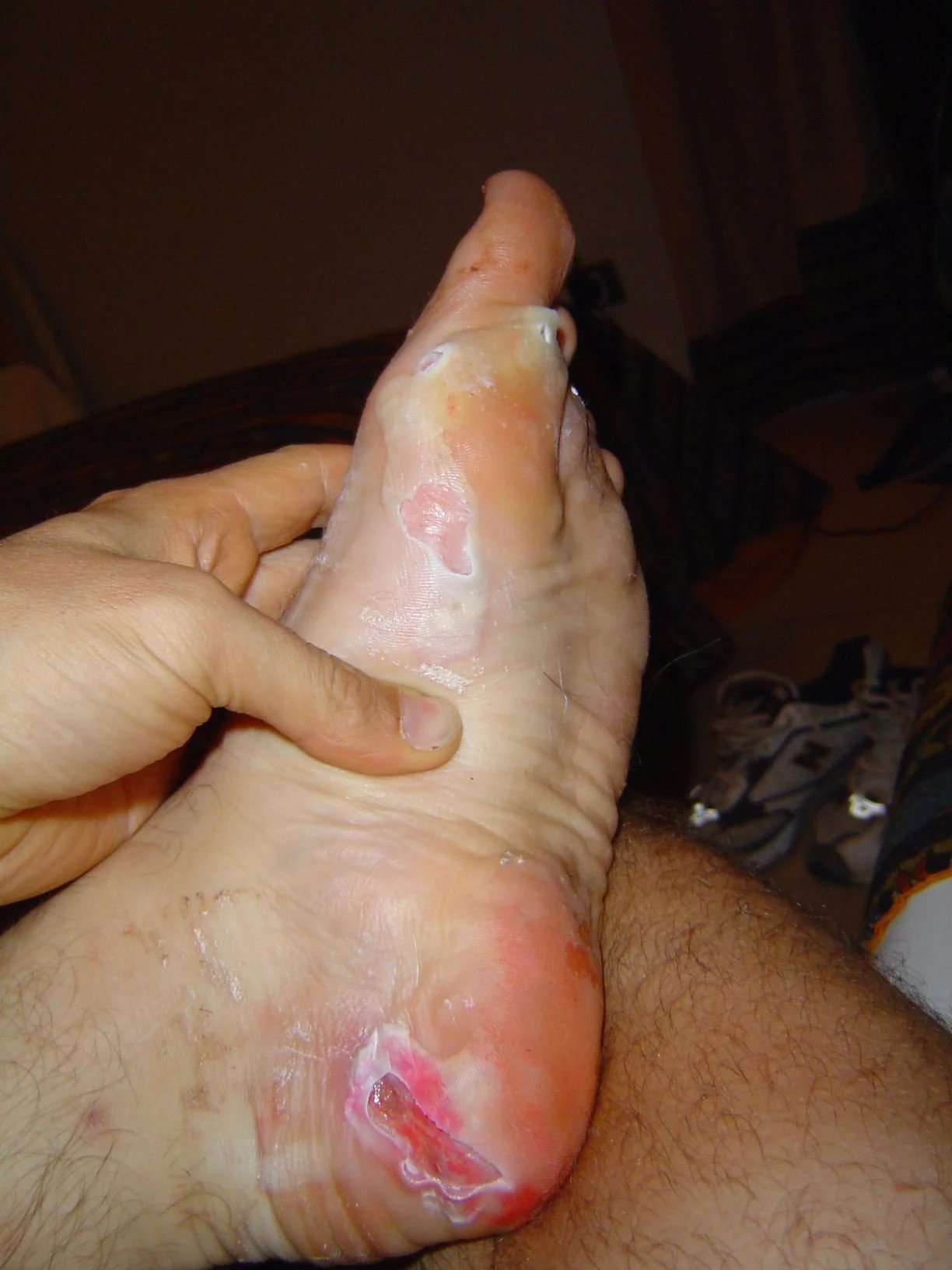
The Toughest Footrace on Earth — and the Season That Framed ItThere is a moment, somewhere out in the Sahara, when your body stops being the thing that carries you and becomes the carcass you have to carry. My feet were a mess of infected blisters. I had been dry-heaving at forty miles of a fifty mile stage. My mind kept offering me the same quiet, reasonable suggestion it had been offering all day; you could stop now, and no one would blame you. Plenty of people around me had already made the same decision.
I chose to hold on. Not because I was fitter, braver, or more adapted to the harsh desert conditions. I kept moving forward because a few months earlier I had been convinced my life was over — and I had promised myself I would never feel that way again.
This is the story of how I came to run 150 miles across the Sahara in April 2004. But it is also the story of my first mental health crisis, and of the legacy it left behind. The two cannot be separated, they are intertwined. I didn’t enter the ‘toughest footrace on earth’ because I was an elite athlete looking for a challenge — I signed up because my mental health had collapsed, I’d lost my job, and I needed something powerful enough to run toward before the darkness closed back in. I needed a purpose. The Sahara desert became that purpose. I've written, and will write, more directly about my mental health elsewhere; here, it is the foundation everything else stands on, and I want to be clear about that from the start.
What I didn't fully appreciate at the time was that I ran it in the middle of one of the best seasons of my sporting life — squeezed into the latter stages of a successful rugby campaign with Glasgow Hawks that would end with a clean sweep of trophies. The desert and the cup run happened at the same time. For years I thought of them as two separate stories, but they were always the same one.
When my world fell apart
In 2003 I was training to become a Chartered Accountant. I had landed a role with a Big Four firm — Deloitte — which, on paper, should have been impossible for someone like me. I grew up on a council estate. I had dropped out of university twice. It had taken me five years to finish an undergraduate degree. Getting a training contract with one of the most competitive firms in the country felt like proof that I could finally outrun my own back story.
Then I sat my professional ICAS exams, and I failed two of the four.
The Institute's policy at the time was unforgiving: you couldn't carry forward the exams you'd passed. Fail more than one, and you re-sat them all. So I was facing all four again, and I knew, with total clarity, what a second failure would mean. Deloitte's policy was simple — two strikes and I was out. If I failed again, I would lose my job.
I would like to tell you I responded to that pressure with the level-headed resolve you'd hope for. I didn't. I sank. What began as worry hardened into anxiety, and my anxiety spiralled. I stopped sleeping. My anxious thoughts spun off into despair, and the despair played on a catastrophic loop: failing these exams and losing this job wouldn't just be the end of my career — it would be the end of life. That belief felt not like a fear, but like a fact.
I became withdrawn. I found solace in alcohol, and in other drugs, and it made everything worse. When the exams came around, I couldn't sit them. I was too unwell.
Reaching out
The turning point wasn't heroic. It was the opposite. It was the ordinary, quiet act of admitting I couldn't do this on my own and asking for help.
I went to my GP. I was signed off work for a month. I was prescribed antidepressants and sleeping tablets — not as a cure, but as a crutch - a way of creating enough of a gap between me and my anxiety so that I could get my feet back under me. That's exactly what they did. The insomnia eased. I had a short course of Cognitive Behavioural Therapy (CBT). The catastrophic thinking loosened its grip. The logic of CBT resonated with my rational brain - my thoughts controlled my feelings, which controlled my behaviours. Slowly, I got well enough to go back to work, and well enough to re-sit my exams.
That summer, I toured South Africa with Glasgow Hawks. We won all three matches — an unbeaten tour that lit the fuse on an extraordinary period for the club, the beginning of a run of three consecutive national championships. It should have been one of the best fortnights of my life, and in many ways it was. But somewhere out there, between games, I took a phone call from a partner at Deloitte with my exam results.
I had passed three. But I had failed my tax exam — for the second time. That only meant one thing…
When I got home, I was made redundant.
Finding a purpose
Devastated doesn't quite cover it. Everything I had been terrified of had actually come to pass. And yet — and this is the part I still find strange — the catastrophe I had spent months dreading turned out to be survivable. I was still here. The job was gone, but the world hadn't ended.
What I understood, though, was that I could not simply sit in the wreckage and wait to find another job. Idle time was dangerous for me; it was the soil the depression grew in. I needed something enormous and positive to pour all of that churning emotional energy into. Something that would demand everything I had.
So in September 2003, I did something that, on paper, made no sense at all. I signed up for the Marathon des Sables.
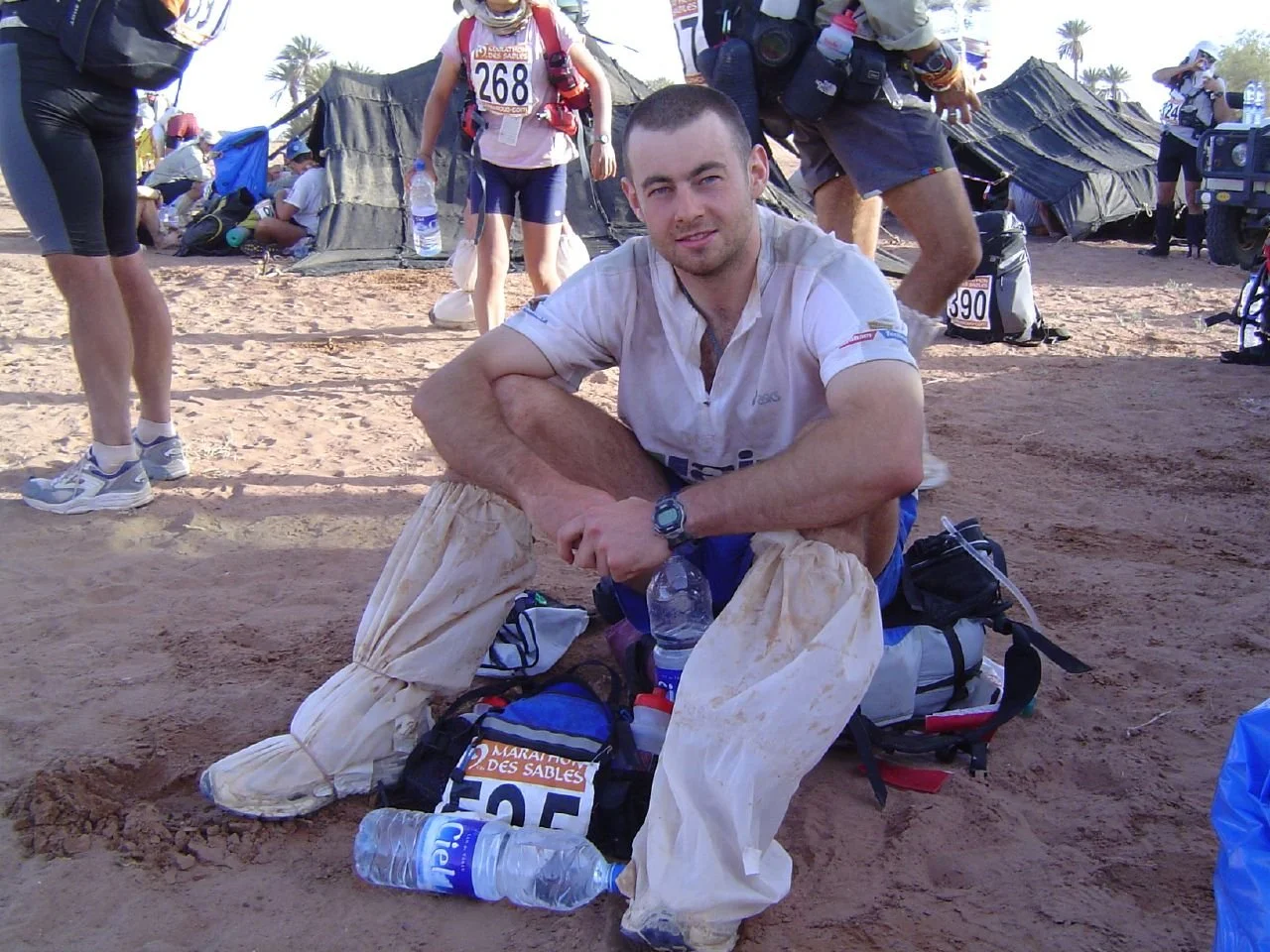
The Marathon des Sables — the “Marathon of the Sands” — is a 150-mile ultramarathon across the Sahara Desert in Morocco, routinely described as the toughest footrace on earth. It's a self-supported stage race run over seven days: the equivalent of roughly six-and-a-half marathons in a week, in daytime temperatures that can climb past forty degrees Celsius and fall to near zero at night. You carry everything on your back — your food, your sleeping bag, your stove, your clothing. The longest single stage is around fifty miles. The shortest, on the final day, is a half-marathon that feels like a victory lap only if you've survived everything before it.
I had six months to prepare. In that time I secured sponsors, sourced specialist desert kit, chased media coverage, and raised over £5,000 for a charity called Facing Africa. In December, I found a new job with a small firm in Edinburgh — which meant, crucially, that I could transfer my CA training contract and finish qualifying after all. The thing I had been convinced was the end of my career quietly became a detour.
But there was a complication; I was still a rugby player. And it was the middle of the season.
The season inside the story
The Marathon des Sables in 2004 ran from the 11th to the 17th of April. That date didn't fall in some convenient off-season gap. It fell right into the sharp end of the 2003/04 campaign with Glasgow Hawks — a season that was, unbeknownst to me at the start of it, building toward something historic.
That year Hawks would win the double: the Premier 1 Championship and the Scottish Cup. The unbeaten South Africa tour the previous summer had been the spark; the season that followed we were on fire. And the Scottish Cup run reached its climax in the exact window I was away. I flew to the Sahara with the cup semi-final already behind us and the final still to come. In other words, I ran the toughest footrace on earth in the gap between a cup semi-final and a cup final.
That timing shaped everything about how I could prepare — which is to say, I barely could. I was still training with the club twice a week and playing every Saturday. On other weekdays I was working hard in the gym. There was no room in the calendar for the long, grinding endurance sessions that any sane person would build before attempting six marathons in the desert. My longest training run in the entire build-up was thirteen miles, done on a cold spring Sunday morning in Glasgow, the day after a match. Thirteen miles. For an event where a single stage would be nearly four times that, in fifty-degree heat, with a pack on my back.
By any rational measure of physical preparation, I was not ready. I went anyway. And what I learned in the desert is that being “ready” was never really the point.
Into the fire
The human body is an extraordinary and fragile machine when you ask it to work in that kind of heat. As the temperature around you climbs, your body fights to hold its core at 37°C — your heart rate rises to push more blood to the skin, and you sweat to shed heat. But running generates its own metabolic heat on top of everything, and in the Sahara the rate at which you gain heat can outpace the rate at which you lose it. When that happens, your core temperature starts to climb, and you slide toward heat exhaustion and, beyond it, the genuinely life-threatening territory of heat stroke.
On the second day, my blisters became severely infected. The medics did what desert medics do — they sliced the blisters away, painted the raw flesh with iodine, dressed it with Compeed and tape, and sent me back out to run on it. You learn very quickly that pain, out there, is simply information. It is not a reason to stop.
The long stage — around fifty miles — was where it nearly ended for me. I ran that day with two vastly more experienced runners from Italy, and I made the classic mistake of a novice: I tried to hold their pace. I over-extended myself, and I paid for it. By forty miles I was severely dehydrated, deep into heat exhaustion, and dry-vomiting into the sand. At the checkpoint the medics gave me rehydration salts. I drank them and brought them straight back up. That was the dangerous moment — I now urgently needed to replace the water and salts I'd sweated out to stop my condition tipping toward heat stroke, and I couldn't keep anything down. The only option left was to put it in through a vein. I took three bags of fluid intravenously and camped there at the checkpoint for the night, convinced my race was over.
In the morning, I got up and finished the last ten miles of the stage.
On repeat
The physical hardship of the Marathon des Sables is extraordinary, but it is not, in the end, what the race is about. Once your body is broken — and by the middle of that week mine was thoroughly broken — physical fitness becomes almost meaningless. What's left is the mind. The entire challenge plays out in your head, and the only question that matters is whether the part of you that wants to stop can overrule the part of you that wants to keep going.
Before I left, Hugh Barrow — then club secretary of Glasgow Hawks, and in his own day a truly world-class runner — had sent me an excerpt from Rudyard Kipling's poem If:
If you can force your heart and nerve and sinew
To serve your turn long after they are gone,
And so hold on when there is nothing in you
Except the Will which says to them: ‘Hold on!’
Out on the long stage, I began repeating those lines to myself like a mantra. Over and over, up and over the huge dunes, across the dry, rocky lake beds, when my heart and nerve and sinew really had gone and there was nothing left in me but the will telling them to hold on.
I listened to ‘No One Knows’ by Queens of the Stone Age on repeat:
I journey through the desert…….of the mind with no hope.
With five miles still to run, something broke open in me and I began to bawl — not from despair this time, but because I knew the end was in sight, and I knew, finally, that I was going to finish.
I wasn't the only one being pushed past what I thought possible. On the marathon stage the following day, I ran alongside a man who suffered from agoraphobia — a fear of open spaces. He had come to the widest, most open place on earth, the Sahara, deliberately, to confront it. His reason undid me: he wanted to be well enough to take his infant daughter to the local park and play with her without fear. He had crossed a continent to face down his terror so that his little girl could have an ordinary childhood. I was moved to tears, and lifted somewhere beyond my normal understanding of what people are capable of.
After that, giving up was no longer an option for me. I had too many people at home supporting me. I had sacrificed too much to be there. I had my own fears and self-doubts to answer to, and here was a man answering his, one stride at a time, for the sake of someone he loved.
The finish line, and what waited beyond
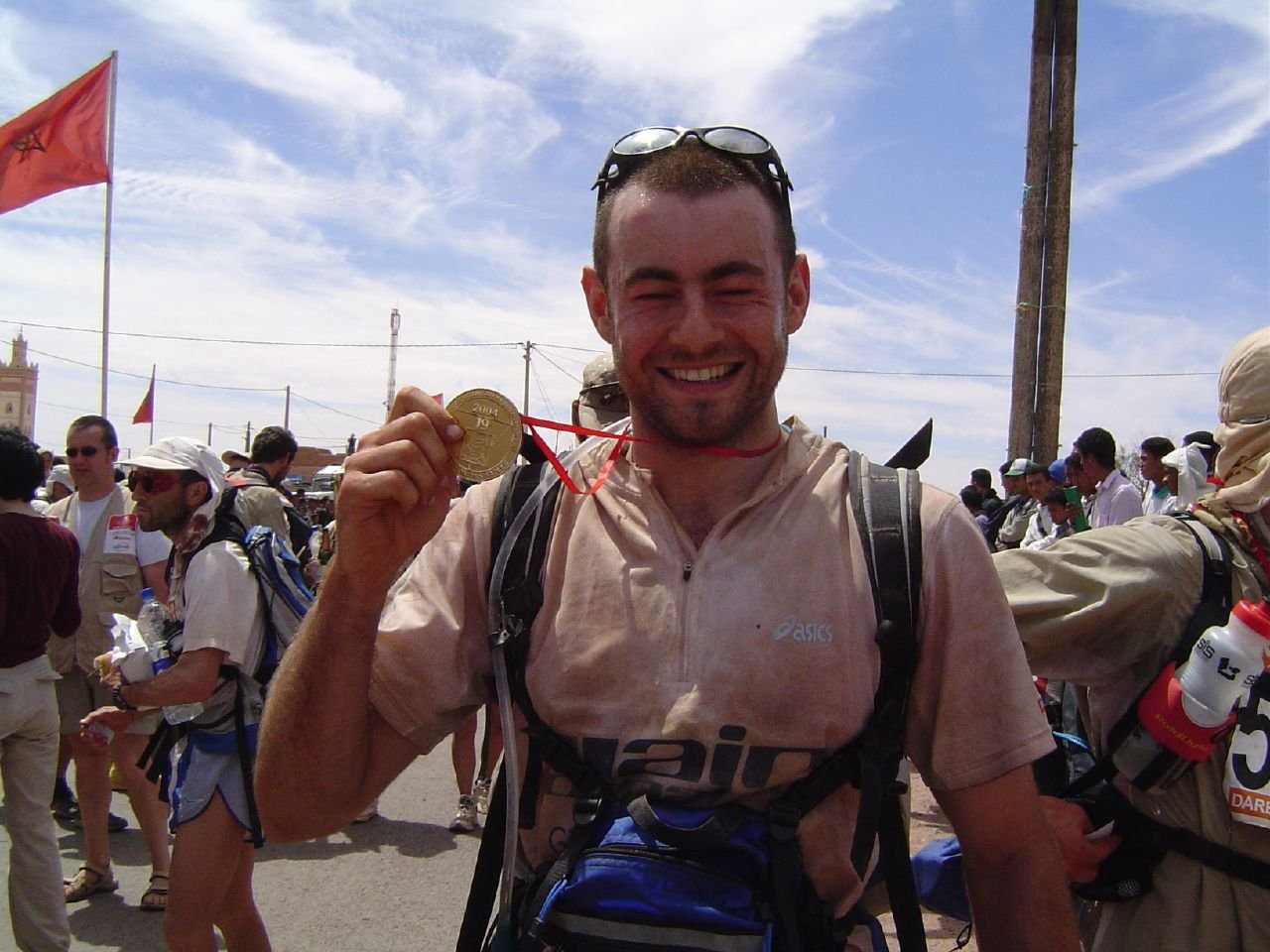
On the last day I ran the closing half-marathon in a little over two hours. My pack was light — most of my food was gone — and I was filthy, sunburnt, bandaged and bedraggled. But when I crossed that line I felt a kind of elation I have rarely experienced since. Pure, uncomplicated, hard-won relief, and a quiet joy.
As I stood there, I watched another runner come in holding a short length of rope out in front of him. Another runner held the other end. It took me a moment to understand what I was seeing: the man behind was blind, and the man in front was his sight guide, and together they had just crossed 150 miles of Sahara. I had achieved something I could only ever have dreamed of — and this man had done the same thing without the use of his eyes. I stood there overawed. Whatever I thought I had learned about limits, the desert kept showing me people who lived beyond them.
I flew home to a season that wasn't finished. The Scottish Cup final was still to come, and Glasgow Hawks were still chasing a double. The club would go on to complete it — Premier 1 and the cup — building on the momentum that the South Africa tour had begun. I had gone away in the middle of it, a broken and redundant trainee accountant, and I returned as something else. The bruised, blistered, hollowed-out man who rejoined his teammates for the run to the final was not the same one who had left.
Lessons of failure
For a long time I thought of 2003 as the year I nearly lost everything. Failed exams. Lost job. Lost sleep, lost perspective, lost — for a while — the will to keep going. And all of that was real; I don't want to varnish it, because if you are somewhere in the middle of your own version of it right now, you need to know that the despair was genuine and I am not pretending otherwise.
But looking back now, I reflect on that year from a different perspective. Failing my professional exams turned out to be one of the most transformative experiences of my life. It forced me to reach for help, which taught me that sharing a burden is a strength and not a weakness. It stripped away the thing I had built my whole identity on and showed me I could survive without it. And it drove me, out of sheer need for something to run towards, into a desert that rebuilt me.
I learned out in the wilderness that resilience and mental toughness are not the same thing. Resilience is what gets you through the bad stretch — it helps you survive. Mental toughness is different; it's the ability to look at the hardest thing in front of you and see an opportunity rather than a threat, and to keep choosing to move forwards when every instinct says stop. The desert taught me that the will which says ‘Hold on’ is real and can be trained.
I came home from the Sahara and completed my professional training as a Chartered Accountant after all. But more than that, I was no longer afraid of failure. I promised myself I would never again let my own fears or self-doubt dictate my future. In time, that promise guided me from the dunes of Morocco to the highest point on earth — but that is another story, and it started here, in the short gap between a cup semi-final and a final, on a pair of bandaged feet, holding on, and holding on.
And so hold on when there is nothing in you